Dental Implants vs. Bridges vs. Dentures: Which Is Right for You?
Losing a tooth is more than a cosmetic concern. Every gap in your mouth quietly triggers a cascade of changes — the jawbone underneath begins to shrink, neighbouring teeth drift out of alignment, your bite shifts, and over time, even your facial structure can change. The good news? Modern dentistry offers three proven solutions: dental implants, dental bridges, and dentures. But choosing the right one depends on a host of factors that only a qualified prosthodontist can properly assess.
As a prosthodontist, my entire specialty is focused on restoring and replacing teeth. Every week I have patients sit across from me, genuinely confused about which option to choose. This article is my attempt to give you the honest, clinically accurate comparison you deserve — without the marketing spin.
Why Replacing a Missing Tooth Matters
Before we compare the options, it is worth understanding what happens when you do nothing. The tooth root does far more than anchor the tooth — it constantly stimulates the jawbone through the forces of chewing. When that root disappears, the bone has no stimulus and begins to resorb (dissolve). Within the first year alone, you can lose up to 25% of bone width in the area.
Adjacent teeth then begin to tip into the gap. The opposing tooth, with nothing to bite against, can super-erupt (grow downward or upward out of position). These changes affect chewing efficiency, speech, and long-term oral health. Replacing a missing tooth promptly is not vanity — it is preventive medicine.
Option 1: Dental Implants
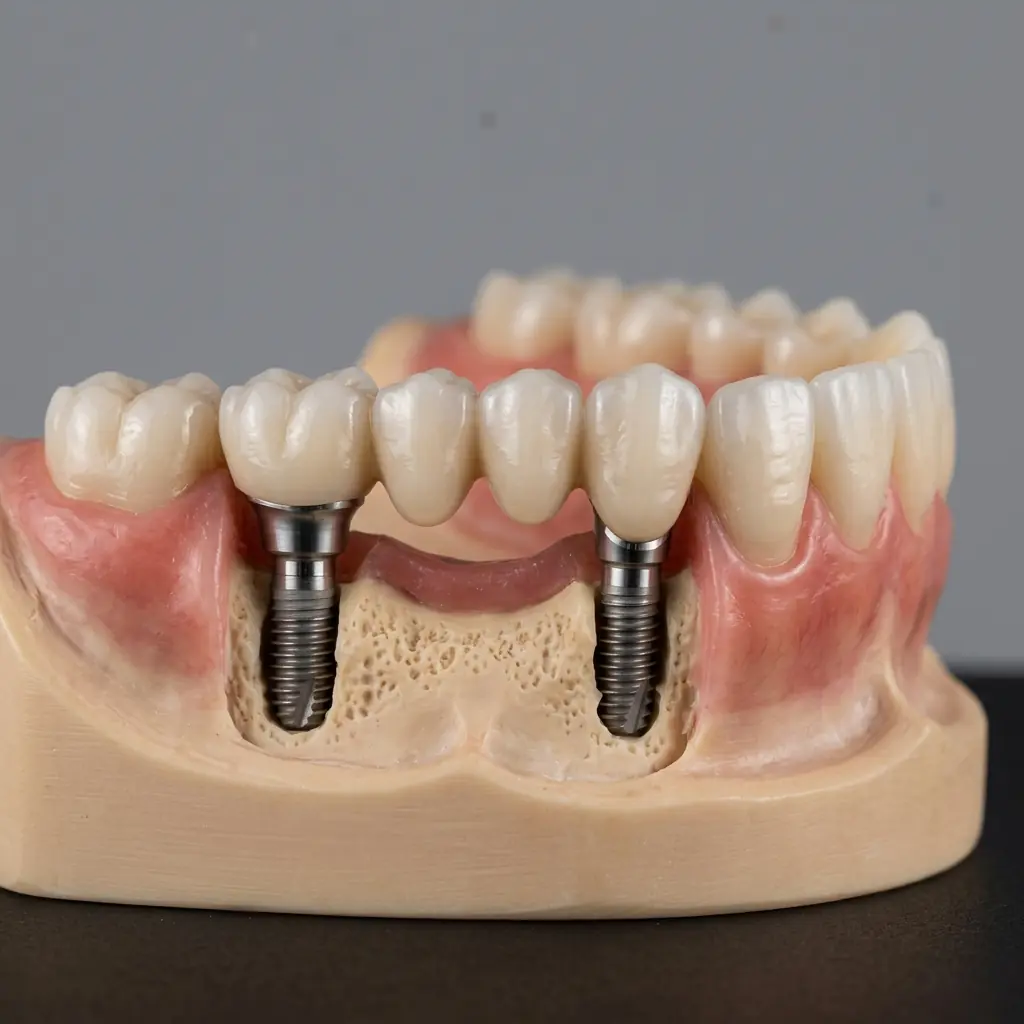
A dental implant is a small titanium post that is surgically placed into the jawbone, acting as an artificial tooth root. Once the implant fuses with the bone (a process called osseointegration, typically taking 3-6 months), a custom ceramic crown is fixed on top. The result is a tooth that looks, feels, and functions exactly like a natural one.
Advantages of Dental Implants
- Permanent and long-lasting: With proper care, dental implants can last a lifetime. The titanium post itself rarely needs replacing; only the crown may need attention after 15-20 years.
- Preserves jawbone: The titanium root stimulates the bone just like a natural tooth root, preventing the bone loss that follows extraction. This is the single biggest clinical advantage of implants over all other options.
- Feels completely natural: Because the implant is anchored in bone, there is no movement, no clicking, no slippage. Patients consistently report forgetting it is there.
- No impact on adjacent teeth: Unlike a bridge, implants do not require grinding down perfectly healthy neighbouring teeth.
- Easy maintenance: You brush and floss an implant exactly as you would a natural tooth. No special adhesives, soaking, or removal required.
- Supports facial structure: By preserving bone volume, implants maintain the fullness of the cheeks and jaw, preventing the sunken appearance that bone loss can create over time.
Disadvantages of Dental Implants
- Higher upfront cost: Dental implants are the most expensive tooth replacement option. In Coimbatore, a single implant with crown depends on the implant brand and complexity.
- Requires surgery: Placement is a minor surgical procedure under local anaesthesia. While complications are rare, the procedure is not suitable for everyone without proper medical clearance.
- Healing time: The osseointegration period means you will not have your final crown for several months. A temporary restoration is usually provided during this time.
- Requires adequate bone: Patients with significant bone loss may need a bone graft procedure before implant placement, adding time and cost.
- Not suitable for all medical conditions: Uncontrolled diabetes, certain blood disorders, heavy smoking, or radiation therapy to the jaw can affect healing and candidacy.
Option 2: Dental Bridges
A dental bridge literally "bridges" the gap created by one or more missing teeth. It consists of two dental crowns fitted onto the teeth on either side of the gap (called abutment teeth), with a false tooth (pontic) suspended between them. The entire structure is cemented permanently in place.
Advantages of Dental Bridges
- No surgery required: The entire procedure is done non-surgically, making it accessible to patients who cannot or prefer not to undergo implant surgery.
- Faster treatment time: A bridge can typically be completed in two to three appointments over two to three weeks.
- Fixed and stable: Unlike dentures, a bridge is cemented permanently and does not move during eating or speaking.
- More affordable than implants: A three-unit bridge in Coimbatore is a more budget-friendly option, making it a significantly more accessible option.
- Proven track record: Dental bridges have been in use for decades and have a well-established track record of success.
Disadvantages of Dental Bridges
- Adjacent teeth must be prepared: To accommodate the crowns, the dentist must remove a significant portion of healthy tooth structure from the supporting teeth. This is an irreversible process and permanently commits those teeth to being crowned.
- Does not prevent bone loss: Because there is no artificial root in the jaw, the bone beneath the false tooth continues to resorb over time, eventually causing a visible gap between the pontic and the gum line.
- Harder to clean underneath: Food debris and bacteria can accumulate under the pontic. Proper cleaning requires special floss threaders or interdental brushes.
- Limited lifespan: Traditional bridges typically last 10-15 years before they need to be replaced, which means the adjacent supporting teeth are repeatedly subjected to further dental work.
Option 3: Dentures
Dentures are removable prosthetic devices that replace multiple missing teeth (partial dentures) or all teeth in an arch (complete or full dentures). They rest on the gum tissue and, in the case of lower dentures, the underlying bone. Modern dentures are made from high-quality acrylic and porcelain, and with skilled construction, can look remarkably natural.
Advantages of Dentures
- Most affordable option: Full dentures in Coimbatore are the most accessible option for patients with budget constraints.
- No surgery: Dentures are entirely non-invasive, making them ideal for elderly patients, those with complex medical histories, or anyone who cannot tolerate surgical procedures.
- Can replace many or all teeth: For patients who have lost most or all of their teeth, complete dentures can restore basic function and aesthetics relatively quickly.
- Reversible: If a patient's circumstances change, they can upgrade to implants later.
Disadvantages of Dentures
- Slippage and instability: Dentures, particularly lower ones, can shift during eating and speaking. This is one of the most commonly reported complaints and can cause embarrassment and discomfort.
- Accelerates bone loss: Without any root structure stimulating the jawbone, bone resorption beneath dentures is actually faster than with no replacement at all, because the denture base pressing on the gums and bone can compress and damage the underlying tissue.
- Require daily removal and maintenance: Dentures must be removed each night, cleaned, and soaked. This routine can feel burdensome and affects intimacy and spontaneity for many patients.
- Reduced chewing efficiency: Traditional dentures provide only 20-30% of the chewing force of natural teeth. Many patients restrict their diet significantly.
- Ongoing adjustments needed: As the jawbone shrinks and the gum tissue changes shape, dentures require periodic relining or replacement — typically every 3-5 years.
- Adhesives required: Most patients need denture adhesive for a secure fit, which adds ongoing cost and can be messy.
Side-by-Side Comparison
| Factor | Dental Implant | Dental Bridge | Dentures |
|---|---|---|---|
| Permanence | Permanent (lifetime) | Fixed, 10-15 years | Removable, 3-7 years |
| Bone Preservation | Yes — fully preserved | No — gradual bone loss | No — accelerated bone loss |
| Surgery Required | Yes (minor, local anaes.) | No | No |
| Adjacent Teeth Affected | No — independent | Yes — must be crowned | Minimal (partial dentures use clasps) |
| Feel & Function | Identical to natural tooth | Very good | Reduced (20-30% chewing force) |
| Maintenance | Brush & floss normally | Special flossing required | Daily removal & soaking |
| Cost (Approx. INR) | Variable per tooth (Contact Clinic) | Variable (3-unit bridge) | Variable per arch |
| Treatment Time | 3-9 months total | 2-3 weeks | 2-4 weeks |
| Best For | Single or multiple missing teeth; healthy bone; long-term investment | 1-2 missing teeth; healthy adjacent teeth; cost-conscious patient | Multiple or all teeth missing; medical contraindications to surgery |
When to Choose Each Option
Choose Dental Implants If:
- You are missing one or a few teeth and have adequate bone volume.
- You want the most natural-feeling, long-lasting solution available.
- You want to protect adjacent healthy teeth from being altered.
- You are medically healthy and willing to undergo a minor surgical procedure.
- You are thinking long-term and want a lifetime solution, not a repeat expense.
Choose a Dental Bridge If:
- You are missing one or two teeth but the adjacent teeth already have large fillings or crowns and need to be crowned anyway.
- You cannot undergo surgery due to medical reasons.
- You need a faster solution and cannot wait 3-6 months for osseointegration.
- Cost is a significant constraint but you still want a fixed, non-removable option.
Choose Dentures If:
- You are missing most or all of your teeth.
- You have significant bone loss that makes implant placement difficult or impossible without extensive bone grafting.
- Budget is the primary limiting factor.
- You have health conditions that make surgery high risk.
- You are looking for an interim solution while planning for implants later.
Implant-Supported Dentures: The Best of Both Worlds
It is worth mentioning a hybrid solution that has transformed full-arch tooth replacement: implant-supported dentures. By placing as few as two to four implants in the jaw, a denture can be anchored securely, eliminating the slippage problem while still being more affordable than replacing every tooth individually. This option — sometimes called "All-on-4" or snap-on dentures — is increasingly popular among patients who need full-arch restoration but cannot afford 8-10 individual implants.
"My first recommendation is almost always an implant for a single missing tooth in a medically healthy patient. The evidence is simply overwhelming — implants preserve bone, protect adjacent teeth, and deliver function and aesthetics that no other option can fully match. That said, every patient is different. I take the time to understand your medical history, your bone quality, your lifestyle, and your budget before making a recommendation. There is no single right answer for everyone — but there is always a right answer for you."
— Dr. Sherin Grace Babu, Prosthodontist, Grace Dental Care
The Bottom Line
Each tooth replacement option has genuine merit. Dental implants offer the most natural, bone-preserving, and durable solution — but they require surgery, adequate bone, and a higher initial investment. Dental bridges offer a fast, fixed, and moderately priced middle ground — but at the cost of adjacent tooth structure and ongoing bone loss. Dentures are the most accessible option financially and medically — but they come with the most compromise in function, comfort, and long-term bone health.
The most important first step is a proper clinical examination. Bone levels, gum health, the condition of adjacent teeth, and your overall medical history all influence which option is clinically appropriate for you. Do not make this decision based on cost alone or on what worked for a friend — your mouth is unique.
At Grace Dental Care, we offer all three options under one roof, with specialist-level expertise in every case. We will never oversell you a treatment you do not need, and we will never undersell you one that serves you better in the long run. If you are ready for an honest, no-pressure consultation, we are here.